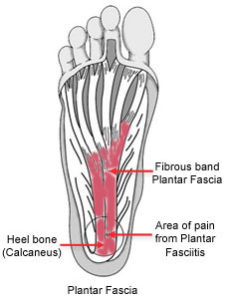
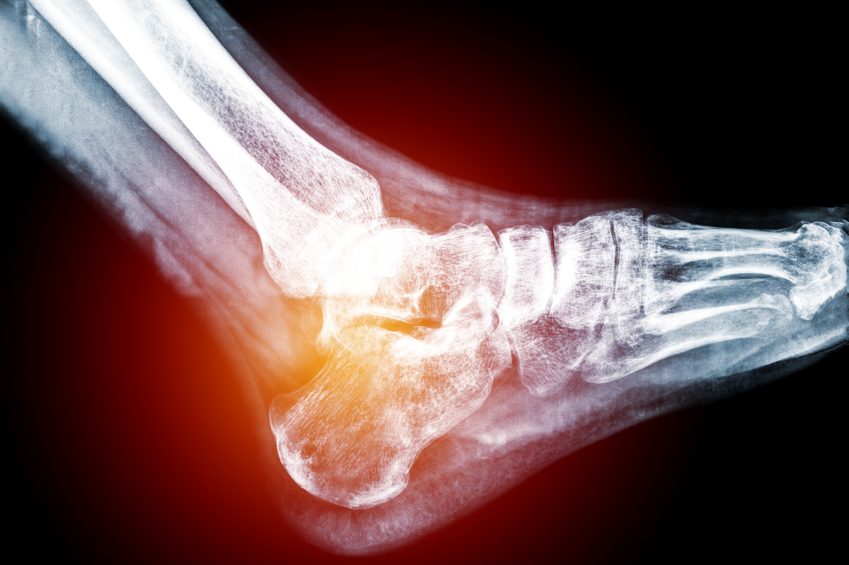
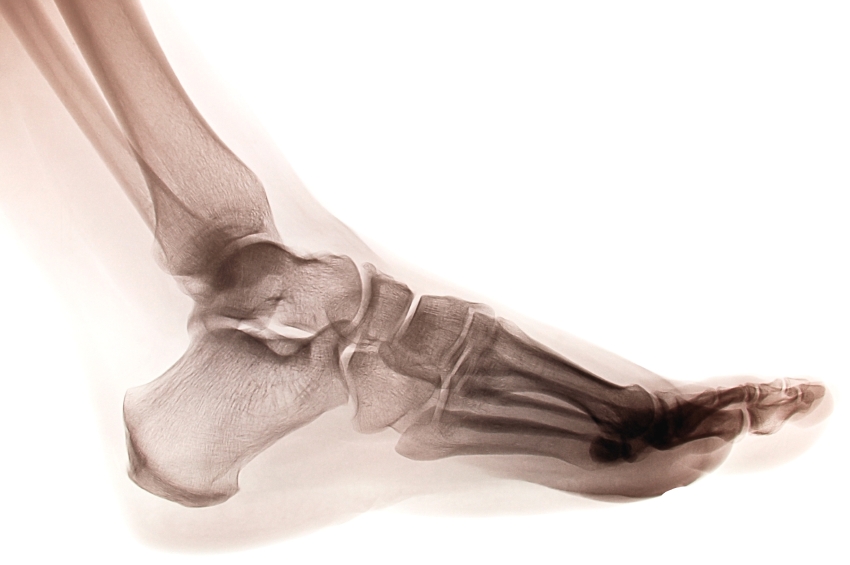
The concise definition of PLANTAR FASCIITIS is consistent pain located on the plantar (bottom) of the heel. Additionally on the medial (inside) along the middle of the entire foot. Specifically, the plantar fascia is a series of fibrosis bands or rather tendon-like structure that extends the entire length of sole of the foot. From the heel bone and extending to the base of the toes/met pads.
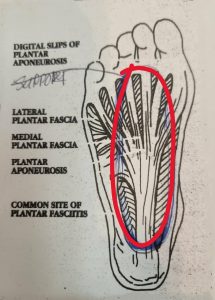
During extended or excessive activity/exercise the plantar fascia can become inflamed and/or may tear under repetitive stress. Heel contact in the walking gait can expose further irritation. Area circled is identified as the medial-plantar fascia location where the plantar fascia attaches to the heel bone. (Please refer to diagram).
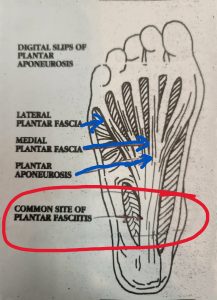
Such pain can be most noticeable when sitting for a while and then standing. Without proper shoe support, the pain can be quite excruciating. Further need for more structured footwear. Yet, I digress. However, more discussion must be done. By that, it is important to highlight the following:
- Ankle Valgus/low arch/low instep =pronation
-
- Ankle roles inward, thus putting more pressure on ankle, knee and hip.
- Please refer to exhibit for additional information
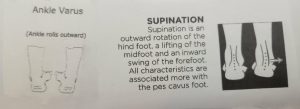
- Ankle Varus/high arch/high instep=supination
-
- Ankle rotates outward, hence more pressure on the anterior of ankle, knee and ball-joint of the hips.
- Further reference for supination is provided by diagram below.
Perhaps most podiatrists and sit and fit footwear stores would suggest orthotics. However, we are not one of them. On the contrary, orthotics only add structure to an unstructured shoe. Indeed, I would argue and recommend a shoe with the necessary construction to place you, the footwear user, in a neutral position.
Yes, the fasciitis sufferer, needs to be centered. Footwear with added counter support, lasting board, shank support and embedded lateral and meta support. As noted in diagram below and highlighted, the support needs to be centered on the direct line of fibrosis bands that connect the plantar with the five meta pads of the toes. Hence. Right distribution will be properly aligned along the center of the foot.
Thus, the plantar fasciitis suffer will be better served with the aforementioned support. Moreover, there is less pressure on ankles, knees and hips.